Understanding Middleware in Express.js
Middleware is one of the most important concepts in Express.js.
At first, beginners usually memorize syntax like:
app.use()
without understanding what middleware actually does.
But middleware is the reason Express applications become:
organized
scalable
reusable
Almost every real-world Express application uses middleware heavily.
What is Middleware?
Middleware is a function that runs between:
receiving a request
sending a response
It acts like a checkpoint inside the request lifecycle.
Middleware can:
modify request data
check authentication
validate input
log requests
stop requests
pass control forward
Understanding Middleware Using a Pipeline Analogy
Think of a request like a package moving through checkpoints.
Example flow:
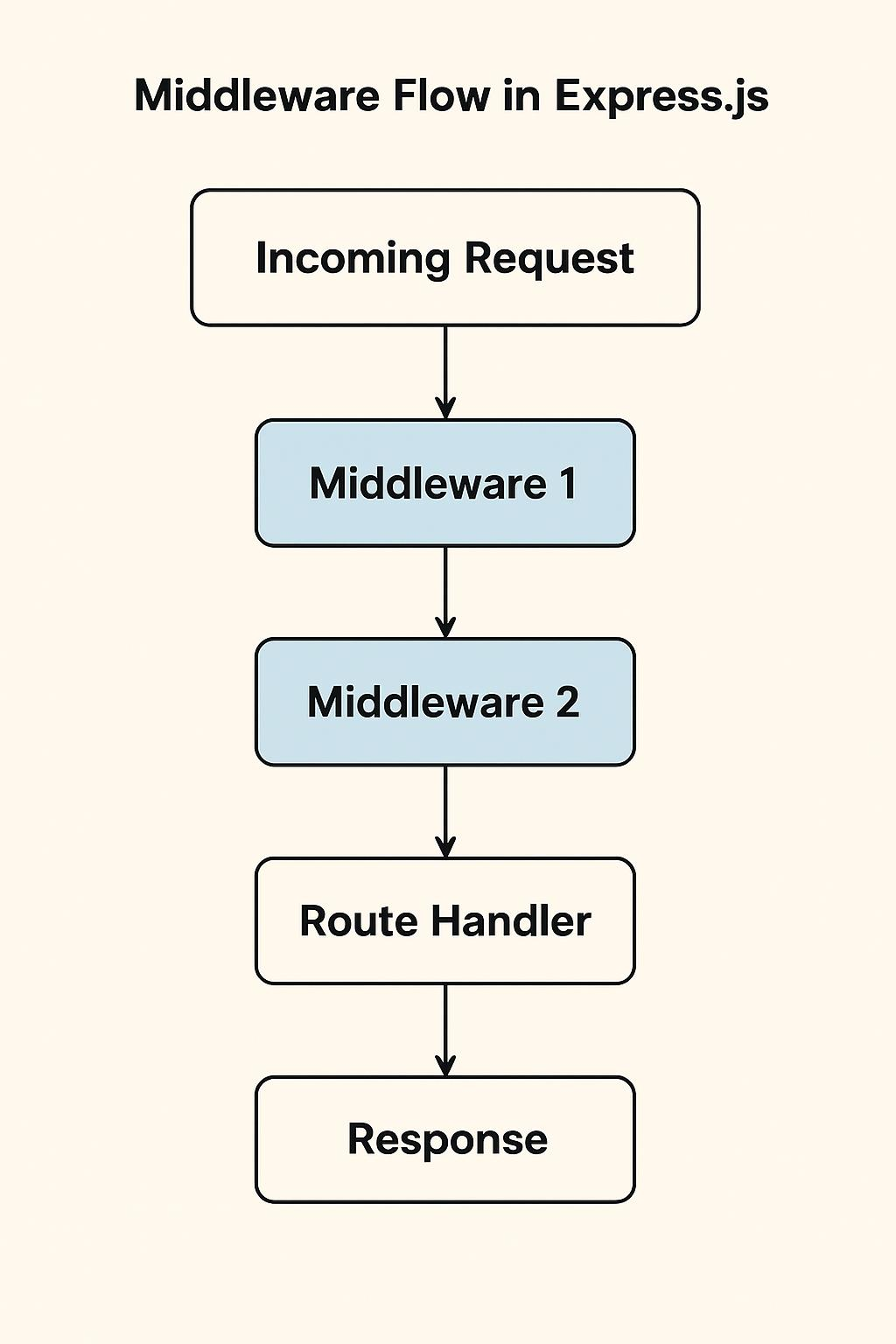
Request → Middleware → Route Handler → Response
At every checkpoint:
request can be inspected
modified
blocked
forwarded
That checkpoint system is middleware.
Where Middleware Sits in the Request Lifecycle
When a request reaches the server:
middleware executes
request gets processed
route handler runs
response is returned
Middleware sits before the final response.
Basic Middleware Example
const express = require("express")

const app = express()

app.use((req, res, next) => {

  console.log("Middleware Executed")

  next()

})

app.get("/", (req, res) => {
  res.send("Home Page")
})
Here:
middleware runs first
next()passes control forwardroute handler executes afterward
Role of next() Function
next() is extremely important.
It tells Express:
“Move to the next middleware or route handler.”
Without next():
request gets stuck
response never reaches client
Example:
app.use((req, res, next) => {

  console.log("Checking Request")

  next()

})
Middleware Execution Order
Middleware runs in the order it is written.
Example:
app.use((req, res, next) => {
  console.log("Middleware 1")
  next()
})

app.use((req, res, next) => {
  console.log("Middleware 2")
  next()
})
Execution order:
Middleware 1
Middleware 2
Order matters heavily in Express applications.
Request → Middleware → Response Flow
Types of Middleware
Express provides different types of middleware.
Application-Level Middleware
Applied to the entire application.
Example:
app.use((req, res, next) => {
  console.log("Global Middleware")
  next()
})
Runs for every request.
Router-Level Middleware
Applied only to specific routes.
Example:
router.use((req, res, next) => {
  console.log("Router Middleware")
  next()
})
Useful for route grouping.
Built-In Middleware
Express already provides built-in middleware.
Example:
app.use(express.json())
This middleware:
- parses incoming JSON data
Without it:
req.bodywould not work properly
Real-World Middleware Examples
Middleware is used everywhere in backend applications.
Logging Middleware
Tracks incoming requests.
Example:
app.use((req, res, next) => {

  console.log(req.method, req.url)

  next()

})
Useful for debugging.
Authentication Middleware
Checks whether user is logged in.
Example:
app.use((req, res, next) => {

  const token = req.headers.authorization

  if (!token) {
    return res.send("Unauthorized")
  }

  next()

})
Protects private routes.
Request Validation Middleware
Checks incoming data before processing.
Example:
email validation
required fields
input sanitization
This prevents invalid requests from reaching business logic.
Why Middleware Matters
Without middleware:
code becomes repetitive
logic gets duplicated
request handling becomes messy
Middleware helps separate concerns cleanly.
Real-World Thinking
In large applications:
- dozens of middleware functions may run for one request
Examples:
logging
authentication
rate limiting
validation
file handling
Middleware creates a structured request pipeline.
How to Think About Middleware
Simple mental model:
request enters server
middleware checks/processes request
route handler sends final response
That is the complete flow.
One Line Summary
Middleware functions process requests between the client request and final server response in Express.js.
Conclusion
Middleware is a core part of Express.js because it allows requests to pass through reusable processing layers before reaching route handlers.
Using middleware properly helps organize applications, improve security, validate requests, and simplify backend architecture.
Understanding middleware is essential for building scalable Express applications.